Online Turbidity Monitoring for Wastewater Discharge in Pakistan
Continuous turbidity monitoring helps wastewater operators respond quickly to water quality changes while reducing the workload associated with manual sampling and inspection.
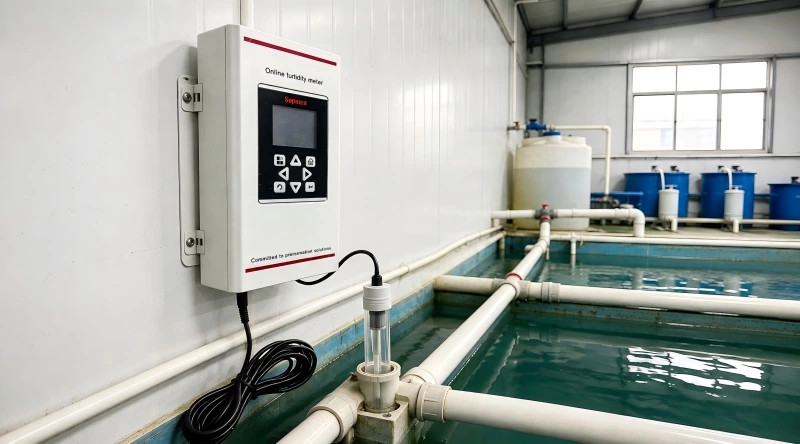
For a wastewater monitoring project in Pakistan, Supmea worked with ABGURT, a local trading partner, to establish continuous turbidity monitoring at the wastewater outlet. A Supmea PTU300 flow-through turbidity meter was selected to provide real-time measurement and transmit data to the customer's monitoring system through both analog and digital signals.
Project at a Glance
| Location | Pakistan |
| Industry | Wastewater |
| Application | Wastewater discharge turbidity monitoring |
| Medium | Wastewater |
| Pipe sizes | DN100 |
| Process temperature | 20–35 °C |
| Process pressure | 0.3 MPa |
| Process flow | 10–80 m³/h |
| Monitoring point | Outlet pipeline |
| Site environment | Humid |
| Communication | 4–20 mA / RS485 |
| Supmea solution | 1 × PTU300 flow-through turbidity meter |
| Measurement range | 0–20 NTU |
| Power supply | 24 VDC |
| Protection | IP54 |
The Challenge
Before the installation of the online turbidity monitoring system, the wastewater operation relied heavily on manual inspection and sampling. Operators had to check water quality frequently, increasing the workload of routine operation and maintenance.
Manual measurement also made it difficult to identify changes in wastewater quality immediately. When turbidity changed between two sampling intervals, operators could not always respond quickly enough to adjust the treatment process.
The project therefore needed a continuous monitoring solution that could:
-
Reduce dependence on manual inspection and sampling
-
Provide faster visibility into changes in wastewater quality
-
Support stable monitoring at the wastewater outlet
-
Transmit measurement data to the existing monitoring system
-
Help operators maintain discharge quality requirements
-
Operate reliably in a humid site environment
Supmea's Solution
Based on the project requirements, Supmea supplied one PTU300-ZCB34C flow-through turbidity meter with a measurement range of 0–20 NTU.
The instrument was configured with 4–20 mA and RS485 outputs, allowing turbidity data to be integrated into the customer's monitoring and control system. A 24 VDC power supply, six-core waterproof electrical connector and IP54 protection were selected to match the site's installation conditions.
The monitoring point was located at the wastewater outlet pipeline, where the main DN100 process line operated at a flow rate of approximately 10–80 m³/h, a temperature of 20–35 °C and a pressure of around 0.3 MPa.
The flow-through measurement arrangement enabled the customer to continuously observe turbidity instead of relying only on periodic manual checks. This provided operators with more timely information when wastewater quality began to change.
The PTU300 was selected primarily for its suitability for continuous wastewater monitoring, communication flexibility and availability for fast project delivery.
Delivery and Project Support
In addition to supplying the turbidity meter, Supmea and its local partner provided support throughout the implementation process, including:
-
Installation guidance for the turbidity monitoring point
-
Commissioning support together with the local distributor
-
Communication and signal configuration support for 4–20 mA and RS485 integration
-
Fast product delivery to help keep the project implementation on schedule
This cooperation between Supmea's technical team and the local distributor helped simplify installation and commissioning for the customer.
Measured Results
After the online turbidity monitoring system was put into operation, the customer reported improvements in both monitoring efficiency and wastewater process management.
The project results included:
-
Approx. 0.01 NTU measurement deviation reported during operation
-
18% reduction in chemical consumption, based on customer feedback
-
30% faster response to water quality changes
-
12% reduction in operation and maintenance costs
-
Manual inspection frequency reduced from once per day to once per week
Reducing manual inspection from daily to weekly represents approximately an 86% reduction in routine inspection frequency, significantly lowering the amount of repetitive work required from operators.
Continuous turbidity data also allowed operators to identify water quality changes earlier. Instead of waiting for the next manual sampling cycle, the operating team could respond to abnormal turbidity trends more quickly and make treatment adjustments when necessary.
Business Value
The project demonstrates how continuous online turbidity monitoring can improve both wastewater treatment visibility and operational efficiency.
By replacing frequent manual checks with real-time measurement, the customer gained a more consistent view of wastewater quality at the outlet. Faster detection of turbidity changes helped operators make more timely process adjustments, while better visibility into treatment performance contributed to lower chemical consumption.
At the same time, the combination of 4–20 mA and RS485 communication made it easier to integrate turbidity measurement into the existing monitoring infrastructure.
With the Supmea PTU300 in operation, the project achieved a practical balance between continuous water quality monitoring, lower manual workload, faster process response and reduced operating costs, providing more reliable support for wastewater discharge management.